Every driver has had this moment. You’re merging onto Route 29, or sitting in the Monday backup on I-95, and a symbol you’ve never seen before lights up on your dash. Is it serious? Can it wait until the weekend?
Warning lights aren’t standardized between manufacturers – a symbol on a BMW may look nothing like the same warning on a Honda. But once you understand how the system is organized, you can make a fast, confident decision about what to do next.
TL;DR
- Color tells you urgency. Red means pullover. Yellow means schedule service soon. Green and blue just confirm a system is on.
- A flashing check engine light means stop driving. It usually indicates an active misfire, which can destroy a catalytic converter within a few miles. Solid means book a diagnostic.
- A red battery light means your alternator isn’t charging, not that your battery is weak.
- When several lights come on at once, it’s usually one problem. Many manufacturers deliberately disable ABS and traction control when the engine computer reports a fault.
- In Maryland, an illuminated check engine light is an automatic VEIP failure – and clearing the code yourself just fails you for incomplete readiness monitors instead.
- Not sure what you’re looking at? Call LMT at (410) 730-3839. For a red light on a car you don’t trust to drive, our 24-hour towing line is (410) 740-8822.
Start With the Color
Automakers follow traffic-light logic across nearly every make and model. Red means stop – there’s a safety issue or a condition that causes damage if you keep driving. Yellow or amber means something has failed, but you can usually drive to a shop. Green or blue is informational.
That single distinction handles most of the decision-making.
Red Lights: Address These Immediately
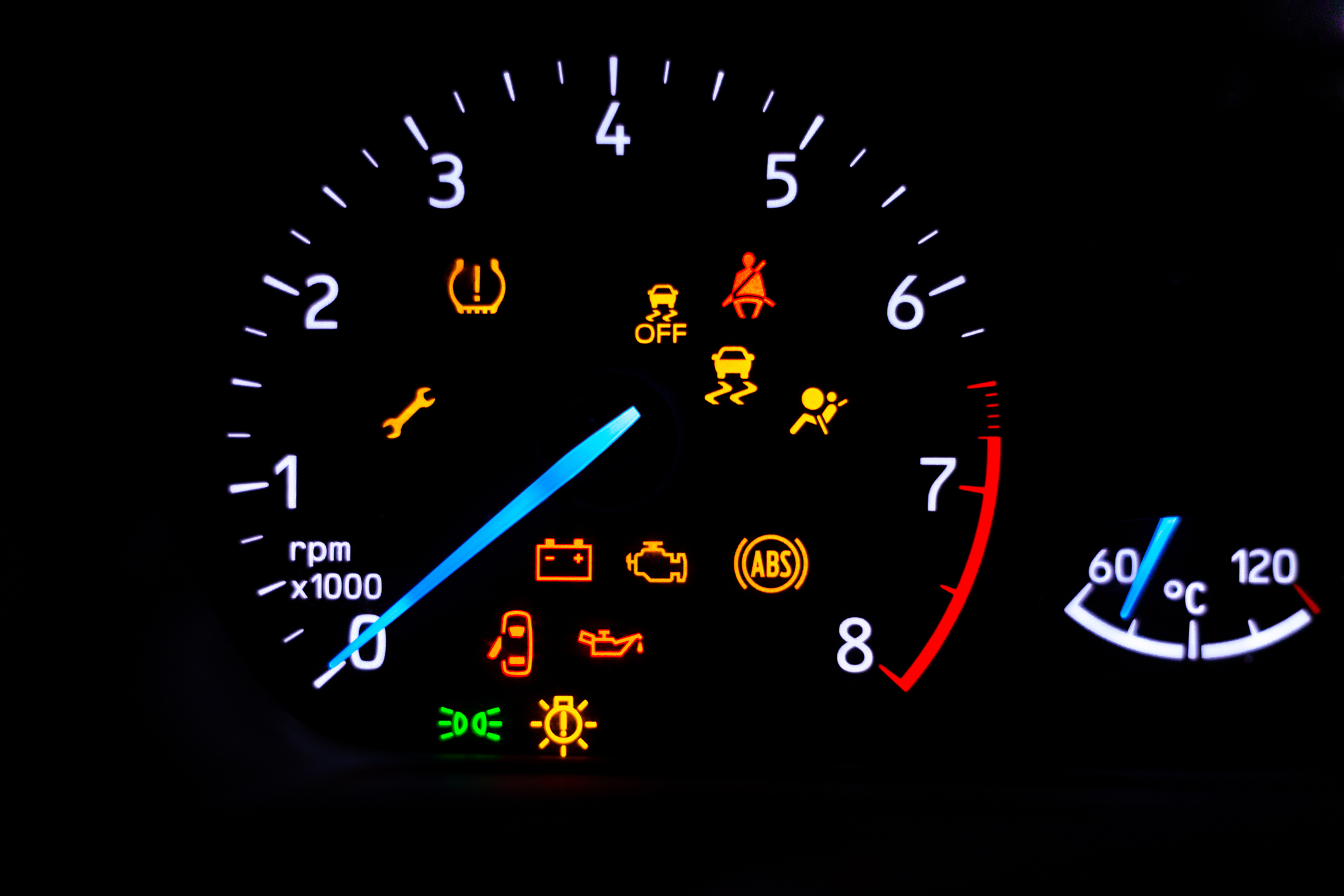
Oil pressure (an oil can symbol) means low pressure, not just low level. Your engine can be destroyed in minutes without pressurized oil. Pull over and shut it off. If the light stays on after adding oil, or you hear ticking or knocking, don’t drive it.
Coolant temperature (a thermometer in liquid) glows blue at cold start on many Mazdas, Subarus, and European vehicles – that’s normal. Red means overheating, which can warp a cylinder head or blow a head gasket. Summer traffic on the Beltway is a common place for this to appear, because stop-and-go driving gives your cooling system almost no airflow. Pull over, let it cool, never open a hot radiator cap, then have the cooling system inspected.
Battery / charging system does not mean a low battery. It means your charging system isn’t charging – usually a failing alternator, a bad belt, or a corroded connection. You’re now running on stored power only. Shut off the radio and A/C and drive straight to a shop. This is a job for electrical diagnosis.
Brake system appears as the word BRAKE, a (!) in a circle, or a (P) in a circle. If your parking brake is engaged, it’s just a reminder. If the light stays on with the brake fully released, you likely have low brake fluid – meaning worn pads or a leak. If the pedal feels soft or travels farther than normal, stop driving and call for a tow. Otherwise get in the same day for brake service.
Airbag / SRS (a seated figure with a circle in front of it) means the restraint system has a fault and won’t tell you where. When this light is on, your airbags may not deploy in a crash – or may deploy when they shouldn’t. It’s also an automatic Maryland safety inspection failure.
Security / anti-theft (a key or padlock) means the immobilizer can’t recognize your key, and the vehicle may not start at all. Sometimes it’s a weak fob battery; sometimes it’s the receiver or module.
Yellow Lights: Get It Looked At
Check Engine Light
The engine outline, or SERVICE ENGINE SOON. It comes on when your vehicle’s computer stores a trouble code, which could mean anything from a loose gas cap to a failing catalytic converter.
The critical distinction is solid versus flashing:
- Solid – schedule a diagnostic and note how the vehicle drives.
- Flashing – stop driving. This typically signals an active misfire, dumping raw fuel into the exhaust and destroying the catalytic converter. Driving another twenty miles to save a trip can turn a few hundred dollars into a few thousand.
You may also notice other lights come on with it – ABS, traction control, stability control. That’s not a second failure. Honda, Toyota, and others intentionally disable systems that rely on engine data when the engine computer reports a fault, as a protective measure. Fix the root cause and those lights typically clear together.
Reading a code takes minutes. Correctly interpreting it is where experience matters – the code tells you which circuit reported a problem, not which part failed. We perform check engine light diagnosis daily.
ABS Light
Anti-lock brakes keep your wheels from locking during hard braking so you can keep steering. When this light is on, that assistance is offline. Your standard brakes still work – but in a panic stop on wet pavement or the black ice that forms on Maryland bridges and overpasses, you’re on your own. Usual causes are a failed wheel speed sensor, a damaged harness, or a module fault.
Tire Pressure (TPMS)
An exclamation point inside a horseshoe. Maryland drivers see this most during the first cold snap, because pressure drops roughly 1 PSI for every 10 degrees the temperature falls – a tire that was fine in October can trip the sensor in November without a single nail in it.
Watch how it behaves. Solid means check and adjust your pressures. If it flashes at startup and then stays on, that usually points to a TPMS sensor or module fault rather than a low tire. Our tire and alignment team can tell you which.
Traction / Stability Control
A car with squiggly lines beneath it, or ESP/ESC. Flashing briefly while driving means the system is actively working – normal, and genuinely useful on a snowy morning in Howard County. Staying on solid means it has faulted. Your vehicle will feel completely normal right up until the moment you need it.
Service and Oil Reminders
A wrench, a triangle with an exclamation point, MAINT REQD, or an oil life percentage. These are mileage- or algorithm-based reminders, not fault codes – which makes them easy to dismiss, and that’s the problem. They exist to catch wear before it becomes damage.
Our advice on oil life: don’t let it drop below 20 percent. If most of your driving is short trips around Columbia or crawling through rush hour, you’re in what manufacturers classify as severe service, and your intervals should be shorter than the manual’s maximum. We can set a realistic schedule at your next oil change.
Transmission temperature (a gear, sometimes with a thermometer) is rare on modern vehicles, but heat is the primary killer of automatic transmissions. Stop driving, especially if you’re towing.
Diesel-Specific Lights
Glow plug indicator (a curled symbol): diesels have no spark plugs – they use glow plugs to warm the combustion chamber. Turn the key to the run position, wait for the light to go out, then crank. Cranking early causes hard starts, smoke, and wear on your starter and batteries. It matters most on cold Maryland mornings.
DEF and DPF warnings mean your exhaust fluid is low or your particulate filter is loaded with soot. Ignore them long enough and most vehicles reduce power, then refuse to restart. Worth stating plainly: removing or disabling diesel emissions equipment violates the federal Clean Air Act, and a deleted vehicle will not pass a Maryland inspection. The answer is a proper repair. We handle emission repairs plus box truck, Sprinter and Transit van, and RV service.
Green and Blue Lights: Nothing to Fix
Fog lamps, cruise control, high beams, and turn signals all simply confirm the system is on. Door ajar is worth checking overnight – an interior light left on is a classic dead battery. Washer fluid is a five-minute fix that matters more than people think during salt season.
One exception: on Mercedes, BMW, and Acura, a lamp-shaped indicator can mean a bulb is out, not that your lights are on. A burned-out bulb fails inspection and invites a traffic stop.
Why This Matters in Maryland
Warning lights here aren’t only a maintenance question. They’re a compliance question.
Your check engine light will fail you at VEIP. Maryland’s emissions program covers Howard, Anne Arundel, Montgomery, Baltimore, and Baltimore City among others, with testing every two years. For 1996 and newer vehicles the test is an OBD scan, and an illuminated check engine light is an automatic failure regardless of what your tailpipe is actually emitting.
Clearing the code won’t help. The test also verifies your readiness monitors have completed, and those reset when codes are cleared – so a car with freshly erased codes fails for incomplete monitors instead. If you do fail, you have 120 days to repair and retest, and the first retest is free.
Safety inspection lights matter too. Maryland requires a safety inspection to transfer a used vehicle title, and active ABS, airbag, and brake lights are the kind of finding that stops a sale. We’re a certified station and perform MD State Inspections daily.
Our roads generate their own warning lights. Winter salt on I-95, MD-32, and Route 29 corrodes brake lines and wiring connectors – a leading cause of ABS and traction control faults on older vehicles. Freeze-thaw potholes knock out alignment and shear TPMS sensors. Cold snaps expose weak batteries. Humid summers and Beltway congestion load up cooling systems. The same light in August and February often has a completely different root cause.
FAQs
Can I drive with my check engine light on?
If it’s solid and the vehicle drives normally, you can generally drive it to a shop – but don’t put it off, since a small fault can cascade. If it’s flashing, stop driving. That usually means an active misfire, and continuing can destroy your catalytic converter.
Will my car fail Maryland emissions testing with the check engine light on?
Yes. For 1996 and newer vehicles, VEIP is an OBD scan and an illuminated check engine light is an automatic failure, no matter how well the car runs. Have the fault repaired before you go to the station.
Can I just clear the code myself before my test?
It won’t work. VEIP also verifies that your readiness monitors have completed, and clearing codes resets them – so you fail for incomplete monitors instead. After a real repair, the vehicle needs enough drive time for those monitors to set.
Why did my ABS and traction control lights come on with my check engine light?
That’s usually one problem, not three. Many manufacturers disable systems that depend on engine data when the engine computer reports a fault. Fix the underlying cause and the extra lights typically clear together.
My tire pressure light is on but my tires look fine. What’s wrong?
Tires can be significantly underinflated and still look normal. Pressure drops about 1 PSI per 10-degree temperature drop, so cold weather trips a lot of these lights. Check your pressures first – but if the light flashes at startup and then stays on, that points to a sensor or module fault.
My warning light went off by itself. Do I still need it checked?
Yes, and soon. Intermittent faults are still faults, and the trouble code usually stays stored in the computer after the light goes out – that stored code is what lets a technician find the cause. Intermittent problems tend to become permanent ones at the worst possible time.
Bring It to LMT Auto Repair
If a light is red, treat it as urgent. If a check engine light is flashing, stop driving. If it’s yellow, book service this week. If it’s green or blue, keep going. And if you’re not sure, call us – we’d rather answer a two-minute question than see your vehicle arrive on a tow truck.
LMT Auto Repair has served Columbia and Central Maryland since 1993 from the Dobbin Auto Service Park. We’re family-owned, staffed with ASE certified technicians, and equipped for everything from routine oil changes to complex diagnostics on foreign and domestic vehicles. We don’t just read a code and hand you a parts list – we diagnose the actual cause and tell you what’s urgent versus what can wait.
Call (410) 730-3839 or schedule an appointment online. We’re at 6440 A Dobbin Center Way, Columbia, MD 21045, open Monday through Friday, 7:30 a.m. to 5:00 p.m.
Not drivable? Our 24-hour emergency towing service is at (410) 740-8822. Towing is almost always cheaper than replacing an engine.
Proudly serving Howard, Anne Arundel, Montgomery, and Baltimore counties – along with our fleet customers.